
The Quick Answer (TL;DR)
- Ba Duan Jin (Eight Brocades of Silk) is a traditional series of eight Qigong exercises that harmonize body, breath, and mind.
- It originated in China as a health and longevity practice and remains relevant today for its physical, energetic, and emotional benefits.
Ba Duan Jin and the Legacy of Energetic Wisdom
For centuries, Ba Duan Jin has been practiced by monks, physicians, and seekers of vitality and harmony. Its name evokes refinement: “Eight Brocades” or “Eight Pieces of Silk” alludes to the softness, flow, and value of these movements. It is not gymnastics nor ritual—it is a living form of energetic medicine passed down through generations.
Today, this ancient sequence stands as one of the pillars of the Aknanda method. Why? Because beneath its simplicity lies an extraordinary richness of Taoist principles, energetic function, and pedagogical potential.
What Is Ba Duan Jin (Eight Brocades of Silk)?
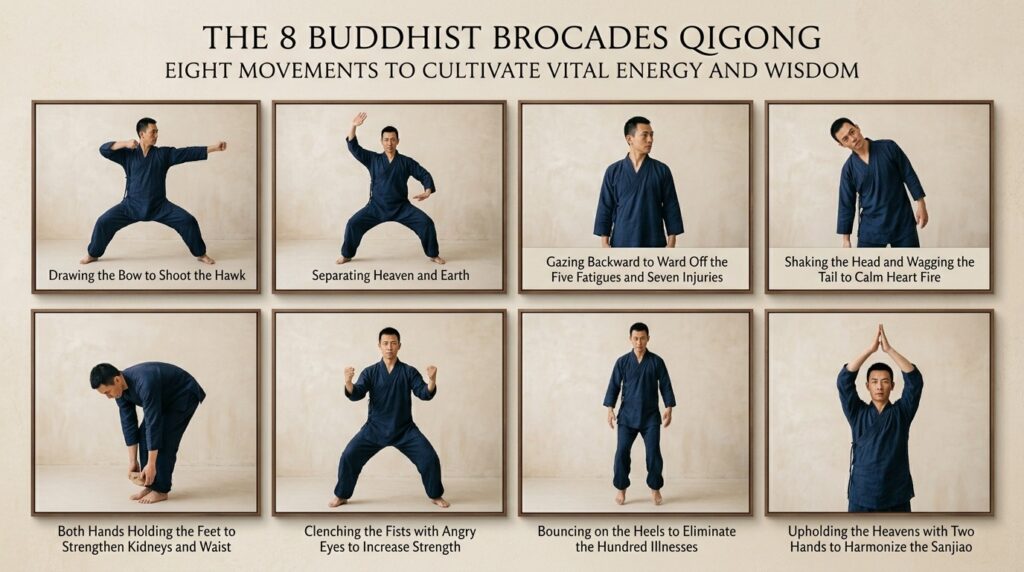
Ba Duan Jin (八段錦), or “Eight Pieces of Brocade” is a classical form of Qigong that combines gentle movement, regulated breathing, and mental focus.
- “Ba” (八): eight.
- “Duan” (段): section or part.
- “Jin” (錦): brocade silk, symbolizing value and harmony.
Each exercise targets specific areas of the body, regulates the flow of Qi (vital energy), and stimulates internal organs according to Chinese Medicine. It is accessible, adaptable, and profound: a gateway to internal work (Neigong), even when practiced externally.
Living History: From Daoyin to Modern Qigong
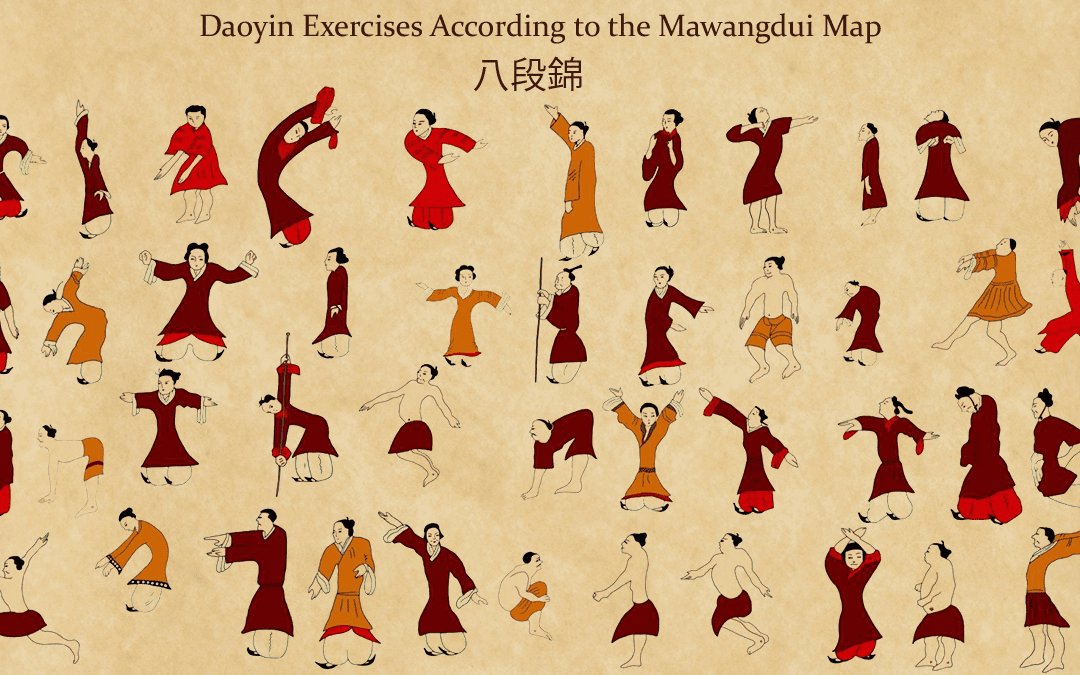
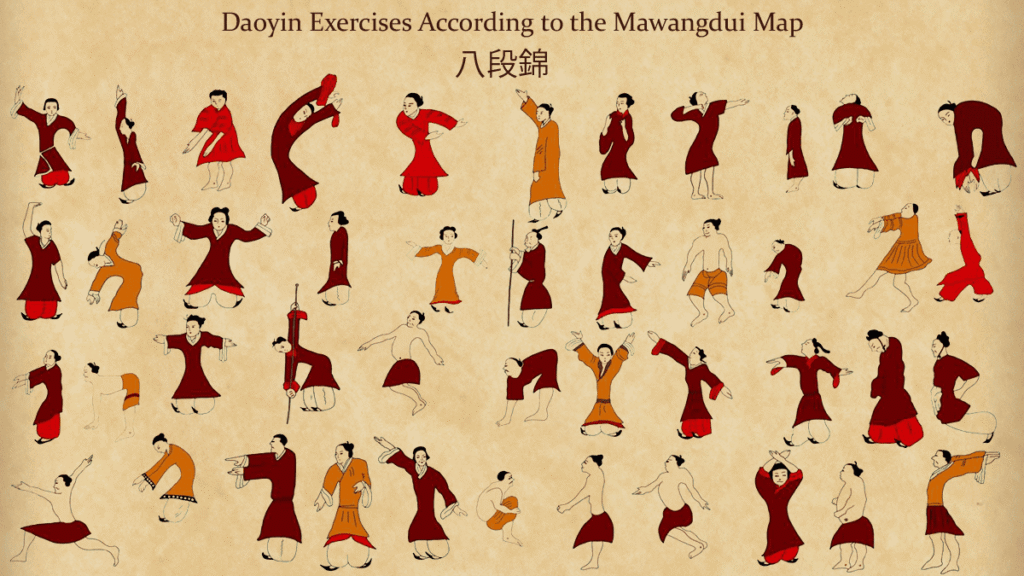
Ba Duan Jin has ancient roots. Its movements are deeply connected to early Daoyin (“guiding and stretching”) practices, with postures documented as far back as the 2nd century BCE in the famous Mawangdui silk texts. Similar forms of movement meditation appear in foundational Taoist works like the Zhuangzi and early health cultivation (Yangsheng) manuals.
While folklore often credits the 12th-century General Yue Fei with its creation to strengthen his troops, historical and scholarly consensus views Ba Duan Jin as a synthesis that evolved organically over centuries within Taoist, medical, and Buddhist traditions. In recent decades, the Chinese Health Qigong Association (CHQA) standardized one version for broader dissemination, with the standing form becoming the most widely practiced. However, numerous traditional lineages and regional variations continue to be taught with equal validity, reflecting the living, adaptable, and personally resonant nature of authentic Ba Duan Jin practice.
Health Benefits of Ba Duan Jin: Traditional Insights and Modern Evidence
Traditionally, the Eight Pieces of Brocade (or Baduanjin) are considered:
- A form of medical Qigong that optimizes the Three Treasures (Jing, Qi, Shen), utilizing movements designed to unblock energetic meridians and regulate key Zang/Fu organs like the Triple Warmer (San Jiao) and the Spleen/Stomach.
- Beneficial for strengthening muscles, tendons, and bones, and for calming the mind and stabilizing emotions by regulating Qi and Heart Fire (xin huo).
Modern research suggests promising benefits, though more long-term studies are still needed. Clinical trials and meta-analyses have reported improvements in:
- Sleep quality, especially in older adults and stroke survivors. Regular practice may help regulate the autonomic nervous system and reduce stress-related disturbances.
- Cardiopulmonary function, including improved vital capacity, respiratory efficiency, and exercise tolerance such as the 6-minute walk test. The coordinated breathing and movement help strengthen the diaphragm and enhance circulation.
- Balance and mobility, particularly in older adults. The standing form challenges both static and dynamic balance, strengthens lower-body muscles and the core, and improves proprioception, reducing fall risk.
- Emotional and mental health, with documented reductions in stress, anxiety, and depression symptoms (Liu et al., 2020). As a form of moving meditation, Ba Duan Jin supports mindfulness, cortisol regulation, and emotional resilience.
Additionally, the seated version (Wenzhi) offers inclusive access to Qigong for people with limited mobility or chronic conditions. Whether practiced standing or seated, Ba Duan Jin remains adaptable, gentle, and effective—providing benefits for joint mobility, breath awareness, and emotional balance. As with all Qigong, consistent and mindful practice over time is key to experiencing its full potential.
Ba Duan Jin in the Aknanda Method: A Foundational Jewel
At Aknanda, Ba Duan Jin is one of the 14 Jewels of Qigong—core forms chosen for their power to develop alignment, grounding, circulation, and internal awareness.
Ba Duan Jin is doorway, path, and method. It is part of the essential groundwork for deeper internal training.
Frequently Asked Questions (FAQ)
How long before I see results?
With just 10–15 minutes daily, many practitioners report better sleep, less tension, and greater mental clarity within a few weeks. Deeper effects build over consistent practice.
Do I need a teacher to learn it?
Ideally, yes. While many resources exist online, guidance allows for better posture, breathing, and use of intention (Yi)—which makes a meaningful difference.
Which version is the real one?
There is no single “true” version. There are standing and seated forms, and variations across martial, therapeutic, and meditative lineages. What matters is intention, not rigid form.
Can I combine it with Yoga or meditation?
Absolutely. Ba Duan Jin complements Yoga, Tai Chi, and meditation, and can serve as preparation or integration for other practices.
What if I have physical limitations?
The practice can be adapted to a chair, or even visualized internally. Qi follows the pathways of the body and mind—even without full outer movement.
