
The Body as a Seasonal Map
The body keeps a calendar older than memory.
While the digital world races out of rhythm, our organs still listen to the turning of the sky.
Chinese Medicine understood this long ago: every organ moves with a season, a flavor, an emotion.
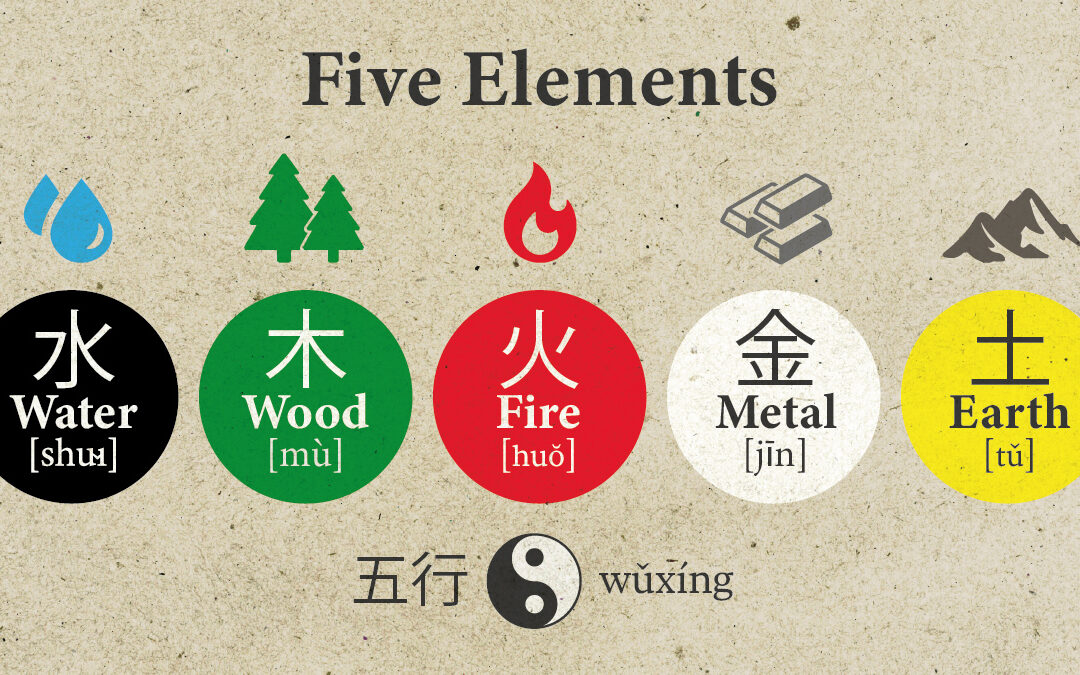
From that insight arose Wu Xing (五行) — the Five Elements: Wood, Fire, Earth, Metal, and Water.
They are not substances but living processes. Originally, Wu Xing was not a medical model but a cosmological one.
The philosopher Zou Yan (4th century BCE) of the Yin–Yang School proposed it as a way to describe how Heaven and Earth renew themselves, how the seasons succeed one another, how both cosmic and human power should flow without force.
Only later did physicians inherit this wisdom to listen to the rhythms of the body.
Health, then, became a form of harmony with time.
What Is Wu Xing (and Why It Is Not “Stuff”)
In Chinese, “行” (xing) means to move or to walk, not to be.
Wu Xing literally means “the five movements”.
It does not name matter but action; it speaks in verbs, not nouns.
Wood grows and expands, Fire rises and radiates, Earth transforms and sustains, Metal contracts and defines, Water stores and nourishes.
They are five ways in which life moves: to sprout, to burn, to digest, to gather, to rest.
Each element embodies a mode of energy and a way of living:
- Wood – growth and purpose.
- Fire – expression and connection.
- Earth – nourishment and stability.
- Metal – clarity and structure.
- Water – depth and resilience.
The Liver stirs in spring, the Heart blazes in summer, the Spleen centers the late summer, the Lungs release in autumn, the Kidneys repose in winter.
Five landscapes, one body.
They live within us:
the liver sprouts in spring, the heart blazes in summer, the spleen centers the year, the lungs release in autumn, and the kidneys store in winter.
Five landscapes, one body.
The Cycles That Sustain Life
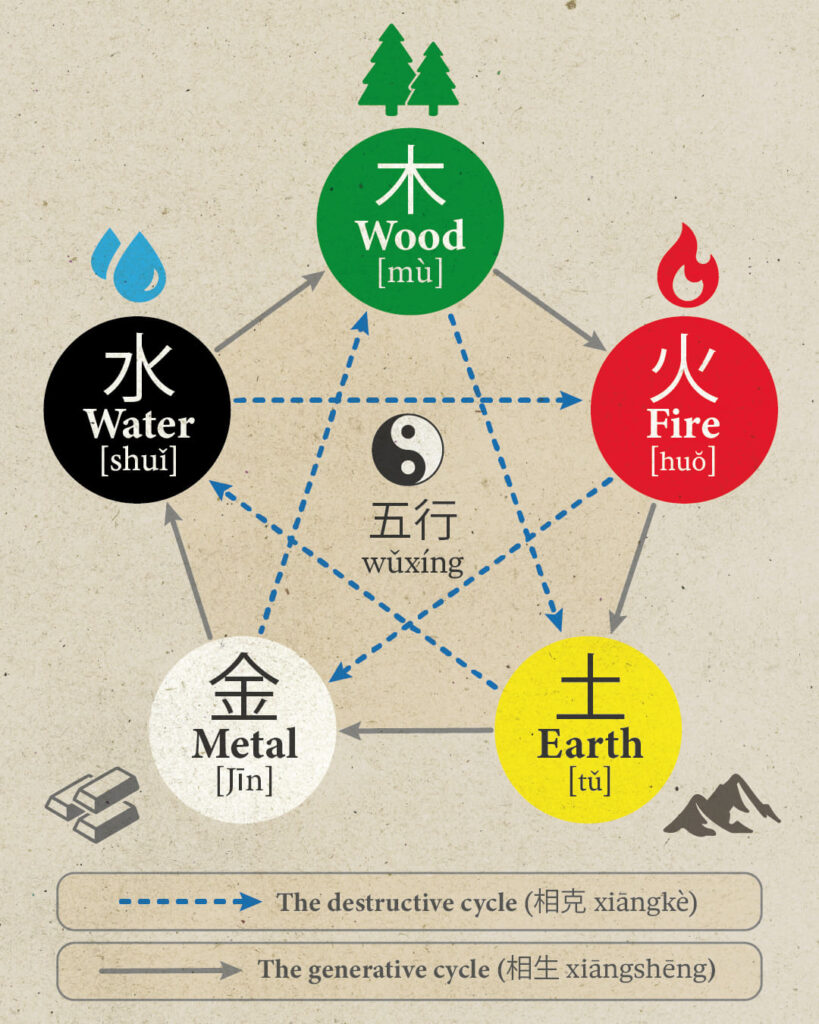
The genius of Wu Xing lies not in naming, but in relationship.
Ancient physicians observed two great laws of balance:
- Generating cycle (Sheng): Water nourishes Wood → Wood feeds Fire → Fire creates Earth (ash) → Earth produces Metal → Metal guides Water.
- Controlling cycle (Ke): Water extinguishes Fire → Fire melts Metal → Metal cuts Wood → Wood penetrates Earth → Earth contains Water.
Creation and control — the inhale and exhale of existence.
When they dance together, life thrives; when one dominates, imbalance appears.
The body, too, survives on relationships, not absolutes.
The Practical Map: Organs, Emotions and Seasons
| Element | Season | Organs (Yin/Yang) | Emotion | Flavor | Movement |
|---|---|---|---|---|---|
| Wood | Spring | Liver / Gallbladder | Anger & Decision | Sour | Expansion |
| Fire | Summer | Heart / Small Intestine | Joy & Elation | Bitter | Ascension |
| Earth | Late Summer / Center | Spleen / Stomach | Worry & Reflection | Sweet (natural) | Transformation |
| Metal | Autumn | Lung / Large Intestine | Grief & Melancholy | Pungent | Contraction |
| Water | Winter | Kidney / Bladder | Fear & Introspection | Salty | Descent |
This chart is not symbolic—it’s physiological.
The emotion you suppress affects its organ; the organ you neglect distorts its emotion.
Grief shortens the breath (Lungs / Metal); fear freezes the lower back (Kidneys / Water).
Emotional balance is not a thought—it is organ harmony.
Wu Xing in Chinese Medicine
In TCM, the elements are diagnostic patterns, not metaphors. Each illness tells a story of broken cycles.
Excess Fire drains Water (insomnia, anxiety); weak Earth fails to nourish Wood (fatigue, sluggish digestion); rigid Metal suppresses Wood (repressed anger, tension).
Treatment — acupuncture, herbs, or Qigong — aims to restore the natural rhythm of generation and control.
Healing is not punishment; it is remembering one’s rhythm.
Qigong: Where Theory Becomes Breath
Qigong (氣功) is the practice where the theory of Wu Xing turns into experience.
Every movement, every breath, re-educates the five currents within the body.
The Three Regulations — body, breath and mind — re-create inside the practitioner the seasons of expansion, ascension, transformation, contraction and rest.
A student does not memorize the elements; they feel them.
Wood in the tendons, Fire in the chest, Earth in the abdomen, Metal in the lungs, Water at the base of the spine.
Qigong turns theory into the quiet certainty of breath.
The Three Treasures and the Five Elements
Behind the movement of the elements flow the Three Treasures (Jing–Qi–Shen) — the essence, energy, and spirit of life.
Jing belongs to Water and the Kidneys; Qi moves through the cycles of Wu Xing; Shen radiates through Fire and the Heart.
They are the root, the current, and the light of the same continuum.
Wu Xing shows how life moves outside; Jing–Qi–Shen shows how it transforms within us — two languages, one truth.
To explore this connection deeper, see The Three Treasures of Taoism: Jing, Qi and Shen in Qigong.
The Attitude in Qigong Practice in Relation to the Five Elements
Within the Aknanda Qigong methodology, the Five Elements are understood as a living framework rather than an abstract theory. They express rhythms, tendencies, and patterns that shape both our physical and emotional landscape. In our core curriculum, forms such as Five Animals Qigong explore these dynamics through movement, breath, and embodied presence. Each posture naturally stimulates the functional expression of a specific organ system and its corresponding channel.
However, even though the Five Elements inform the structure of the practice, we do not approach them intellectually while practicing. The proper attitude in Qigong is simple and attentive: to observe, feel, and refine without forcing. When the mind becomes quiet and receptive, the body guides the process and Qi begins to circulate naturally.
Consistency is essential. Through regular practice, mind and body gradually find their dialogue, and the harmonizing function of Qi unfolds without interference. In this sense, the Elements reveal themselves not through conceptual analysis but through direct experience—through noticing our strengths, our imbalances, and the gradual movement toward equilibrium and clarity.
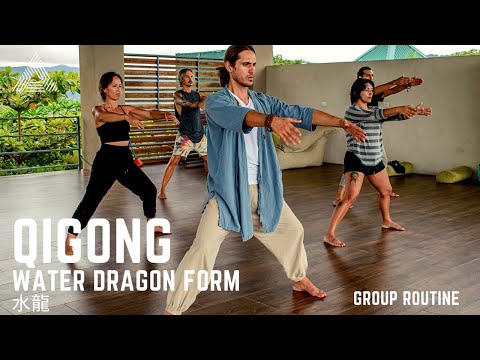
A practice inspired by the fluidity of water — constant transformation, softness, and adaptability.
This form blends low stances, twisting, balance work, and breath to move both body and Qi while preserving Taiji’s Yin–Yang principles.
The Water Dragon awakens the lower Dantian, spine, and kidneys, supporting physical and energetic balance.
Being Seasonal Is a Form of Health
The Tao does not promise stillness — but harmony in motion.
To live by Wu Xing is to move with the seasons: to release in autumn, store in winter, emerge in spring, expand in summer, and return to center through Earth.
The body asks for no miracle — only rhythm.
And every breath, if listened to, remembers the ancient choreography of change.
Science may not yet confirm that these five phases describe physiological facts.
But it has begun to validate what Wu Xing inspires: Qigong to balance emotion, acupuncture to relieve pain, herbal remedies to restore vitality.
Perhaps the value of Wu Xing is not in precision — but in perspective.
In reminding us that health is not a number, but a relationship.
Not a fixed state, but a cycle.
And that the body — wise and quiet — still knows the way back to balance.
FAQs: Understanding the Five Elements in Practice
What are the Five Elements in Chinese Medicine?
They are the five fundamental movements of nature — Wood, Fire, Earth, Metal and Water — linked to organs, emotions and seasons.
How are emotions connected to the elements?
Each emotion corresponds to an organ: anger (Liver), joy (Heart), worry (Spleen), grief (Lungs), fear (Kidneys). Their balance sustains emotional health.
How can I balance my elements?
Through seasonal habits, mindful nutrition, rest, and practices like Qigong or Taoist meditation.
How does Wu Xing relate to Yin and Yang?
Yin and Yang describe energy’s poles; the Five Elements are their movements through time.
What is the link between Wu Xing and Jing–Qi–Shen?
Wu Xing shows how energy flows in the world; Jing–Qi–Shen reveals how that energy refines within us.
