

The Quick Answer
- Ziran (自然) is the principle of naturalness — the way things move when nothing forces them. The word does not mean stillness; it means flow.
- Pu (樸) is the uncarved block — the state you were before conditioning shaped you. Daoists call it original simplicity.
- The two work as one pair. Ziran is the law that governs the Dao. Pu is the state the practitioner returns to. Wu Wei is the way of access — covered in our dedicated pillar.
- In Qigong, Ziran appears in the breath that does not push and the consciousness that does not demand. Pu appears in the Wuji stance, the neutrality before any polarity.
What Ziran Actually Means (And What It Doesn’t)
Most readers meet Ziran in the same sentence as Wu Wei and assume they are synonyms. They are not. Ziran (自然) is not a method, not an attitude, and not the absence of effort. The Zhuangzi is direct about this:
Ziran does not mean being idle or lazy. It is about following your destiny.
Zhuangzi, Outer Chapters
Ziran is what the world does when nothing interferes with it. Water finds the lowest point because that is its true form. A plant turns toward the light, not because it decides to, but because nothing in its constitution opposes the turning. The word translates as naturalness, as spontaneity, and most literally as self-so — that which is by itself. It is the principle, not the practice.
This is why the Dao De Jing places Ziran at the top of its hierarchy. The Dao does not follow a god or a master plan. The Dao follows Ziran. The principle of how things flow when left to their own movement is the only law the Dao obeys.
Understanding this changes how the rest of Daoism reads. Ziran is descriptive: it tells you what the world is. Wu Wei is prescriptive: it tells you how to live without fighting that world. Confusing the two flattens the system.
Pu, the Uncarved Block
Imagine a piece of wood. No defined shape. No assigned purpose. Not yet a table, not yet a chair, not yet a decorative figure. Because it is not yet anything in particular, it can still become anything. The Daoists called this state Pu (樸): original simplicity. The uncarved.
When a craftsman takes the piece and begins to carve, every strike defines and every cut limits. With each form it gains, it loses all the others it could have been. The table can no longer be a boat. The chair can no longer be a bridge. Form, the Daoists understood, is also a renunciation.
You were born like this. Without a name to define you. Without a story to limit you. Without a belief to shape you. Pure possibility. But life is a long series of carvings — what you should want, who you should be, how you should behave. Stroke after stroke, you were defined, and perhaps limited, and you forgot that you once were uncarved wood.
The Dao De Jing names this state directly:
Pure, like an uncarved block of wood.
Laozi, Tao Te Ching (Dao De Jing, 道德經), Verse 15
And later, more pointedly:
Embracing everything, it returns one to the Uncarved Block. When the Block is divided it becomes something useful. But the Sage holds the Block complete.
Laozi, Tao Te Ching, Verse 28
Pu is not innocence and it is not regression. It is the state in which your nature is still your own — before usefulness, before role, before the cuts that made you legible to others.
Ziran and Pu Together: The Self in Daoist Thought
The link between the two concepts is not interpretation. It is right there in the language. The character 自 (zì) means "self" — your own origin, your own source. In the Dao De Jing this single character anchors four terms that describe the same intuition from different angles:
- 自然 zìrán — naturalness, self-so
- 自樸 zìpǔ — original essence, self as uncarved
- 自化 zìhuà — self-transformation
- 自正 zìzhèng — self-determined rectitude
Read together, these four terms say one thing. The nature of a being unfolds when nothing external interferes with it. Ziran is the principle behind that unfolding. Pu is the state the being is in when the principle holds. They are not two doctrines. They are the same insight described from the outside and from the inside.
For Bharu, the order is precise: Ziran is the law, Pu is the state, Wu Wei is the way. If you want to know what the Dao is, you study Ziran. If you want to know who you are before you were shaped, you study Pu. If you want to know how to live in alignment with the law without breaking the state, you study Wu Wei.
From the practitioner's perspective, the order may feel reversed — as our pillar on Wu Wei in Daoism describes, the practice of non-forcing is what opens the door to Ziran, and in that flow the simplicity of Pu is rediscovered. From the cosmological perspective, the order is the one above. The two views are not contradictions. They are the same path read from opposite ends.

The Classical Roots: Dao De Jing and Zhuangzi
The first major statement of Ziran in the Dao De Jing comes in Verse 25, and it places the term at the foundation of the cosmos:
Humankind abides by the principles of Earth. Earth abides by the principles of Heaven. Heaven abides by the principles of the Tao. The Tao abides by the principles of Ziran.
Laozi, Tao Te Ching, Verse 25
Read carefully. The Dao is not the top of the hierarchy. Ziran is. The Dao follows the law of how things are when nothing interferes — and that is what Ziran names.
Verse 17 puts the same principle in a political register. Laozi describes four kinds of ruler from best to worst, and says the highest is the one whose presence is barely felt:
When the work is fulfilled and the mission done, all the people exclaim: this happened by itself.
Laozi, Tao Te Ching, Verse 17
That phrase — this happened by itself — is Ziran. The best government leaves no trace because it never opposes the flow it is meant to serve.
The Zhuangzi tells the same lesson through a parable. In Book VII, three sovereigns appear: Shu (the swift), Hu (the sudden), and Hundun, the sovereign of the center — undifferentiated, complete, without features. Shu and Hu meet often in the realm of Hundun, and Hundun treats them with great kindness. To repay him, they decide to give him what every being should have: seven openings for seeing, hearing, eating, and breathing. They bore one hole a day. On the seventh day, Hundun dies.
The allegory is precise. The action of carving — wèi, what the Daoists called Youwei (有為), the opposite of Wu Wei — kills what was whole. Hundun is Pu. The seven holes are the cuts of identity, role, expectation, and use. The parable does not say Hundun was better before. It says Hundun was alive before.
Ziran in Daily Life: The Cracks in the Learned
Ziran is not something you achieve. It is something that visits.
In an unexpected moment, the original wood breaks through the form. You are in a formal conversation, measured words, controlled gestures — and something makes you laugh. A laugh you did not plan, that you did not authorize, that simply burst forth for a second. The carving cracked, and something uncarved peeked through.
You are trying to sleep. Thinking about problems, calculating solutions. And your body stretches without consulting you, without waiting for permission. A movement that knew exactly what it needed before you did. The original wood still breathes beneath the form.
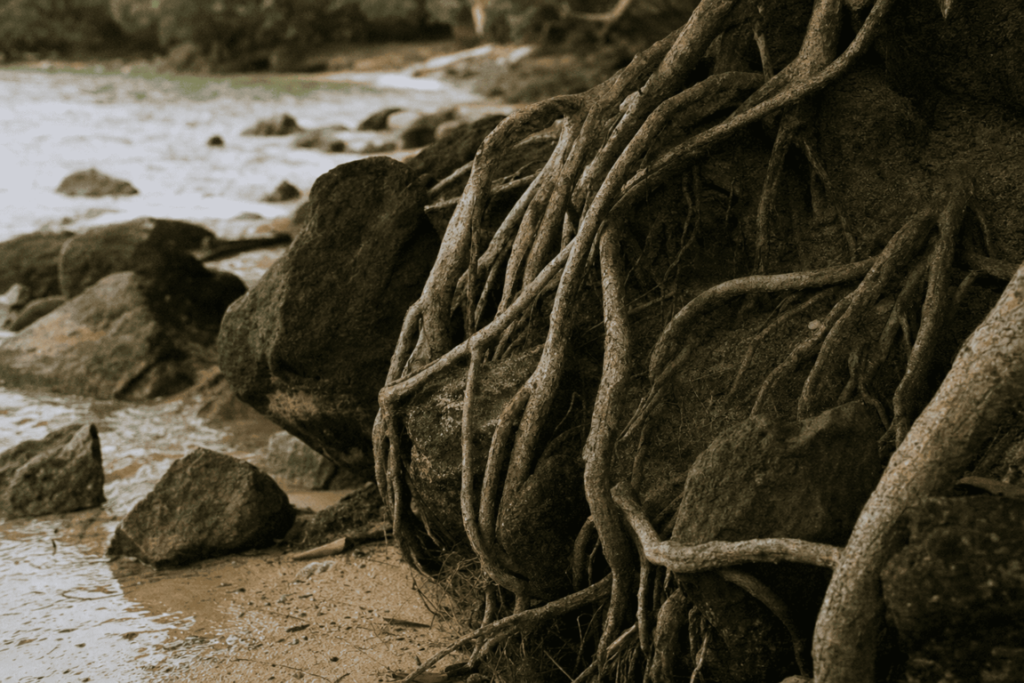
The Daoists called this Ziran. Not a return to Pu — that would be impossible — but Pu peeking through. Like water seeping between stones. Like light entering through a crack. Like roots seeking space.
Ziran is fleeting. It does not stay. And that is exactly why it matters. Because it reminds you that beneath every form imposed on you, the original wood is still alive.
This is also why Ziran should not be confused with impulse. Impulsiveness comes from conditioning. It is a learned pattern triggering automatically — the wound speaking, not the source. Ziran comes from somewhere prior to learning. It feels appropriate even when others do not understand it; impulsiveness feels compulsive, as if you had no other choice. One is the original wood breathing through; the other is the carving doing its old work.
You cannot force Ziran. You can only recognize it when it appears.
Ziran and Pu in Qigong Practice
In Qigong, the two principles stop being theory and become posture, breath, and consciousness.
Ziran in the breath. The practice begins with what Bharu calls baby breath — abdominal breathing, deep and gentle, without forcing and without tension. The point is not to control the breath. The point is to stop interfering with it long enough to feel how it moves on its own. When that happens, the breath is teaching Ziran.
Ziran in the consciousness. There is a phrase in Bharu's teaching for the mind that has stopped demanding from itself: water mind. The water mind flows through the present, attentive and serene, joining each gesture without commanding it. It does not visualize. It does not push. It does not ask the mind to be quiet. It allows the mind to settle the way water settles when no one is stirring it.
Pu in the stance. The most direct meeting with Pu in the Aknanda system is the Wuji (無極) posture — the standing practice known as Zhan Zhuang (站樁). Wuji is neutrality. It precedes Yin and Yang. It is the stance of the practitioner before any polarity has manifested. In medical Qigong, Zhan Zhuang is recommended for anxiety, hyperactivity, and spinal pathologies — but its deeper function is to give the practitioner an embodied experience of what undifferentiated wholeness feels like.
For the method by which these states are entered without effort — the path of non-interference — see our pillar on Wu Wei in Daoism. Ziran tells you what you are aiming at. Pu tells you what you are returning to. Wu Wei tells you how to go.
The Wood Beneath the Carving
Pu is not recovered by carving more. It is remembered by ceasing to carve.
Ziran is not practiced. It is recognized when it appears — in the laugh, in the breath, in the body that knows before the mind does.
What the Daoists offer in these two terms is not a doctrine to memorize. It is a way of paying attention to what was always there, beneath the forms that were given to you.
FAQs: Simple Answers to Common Questions About Ziran and Pu
What is Ziran in Daoism?
Ziran (自然) is the principle of naturalness — the law that governs how things move when nothing interferes with them. It translates as "self-so" or "what is by itself." It is descriptive, not prescriptive: it names how the Dao behaves, not how the practitioner should act.
How is Ziran different from Wu Wei?
Ziran is the law; Wu Wei is the way. Ziran describes the natural flow of things. Wu Wei is the practice of acting in alignment with that flow, without forcing. You study Ziran to understand what is real. You practice Wu Wei to stop fighting it.
What does “uncarved block” mean in Taoism?
The uncarved block is the English translation of Pu (樸), the Daoist image of original simplicity. It is the piece of wood before the craftsman shapes it — pure possibility, before identity, role, and use have been imposed. In the Dao De Jing it appears in Verses 15 and 28 as the state the Sage preserves.
Is Ziran the same as being “natural” in the Western sense?
No. In the West, "natural" often means uncultivated or instinctive. In Daoism, Ziran is closer to true form — the state of something when no external force is bending it away from its own nature. A trained Daoist practitioner is more Ziran than an untrained one, because the practice removes the interferences, not because it adds anything new.
Can you practice Ziran?
Not directly. Ziran is what appears when interference stops. You can practice Wu Wei, which is the discipline of non-interference, and over time Ziran begins to show through. Trying to "do" Ziran is itself the kind of forced action that prevents it.
Where does Pu appear in the Dao De Jing?
The two clearest references are Verse 15, where the masters of the ancient path are described as "pure, like an uncarved block of wood," and Verse 28, which states that embracing everything returns one to the Uncarved Block. The Zhuangzi develops the same image in the parable of Hundun, the sovereign of the center who dies when his openings are bored.
Related posts:


Aknanda Qigong is a wellness brand and academy based in Nosara, Costa Rica, dedicated to the practice and teaching of Qigong, Medical Qigong, and internal martial arts. Founded on authentic Buddhist and Taoist traditions, the method integrates ancient wisdom with modern biomechanics and nervous system regulation. Aknanda offers in-person retreats, online programs, and a 200-hour Teacher Training Certification, all designed to cultivate vitality, mental clarity, and longevity. Recognized as the Best Wellness Center in Central America & the Caribbean, Aknanda Qigong serves a global community of practitioners seeking holistic transformation.
