The Quick Answer (TL;DR)
- Wu Wei (無為) means “effortless action,” not laziness.
- It is about flowing with the Dao rather than forcing against it.
- In Qigong, it appears as relaxed posture, natural breathing, and calm intention.
- In Neigong and Neidan, it guides transformation to unfold naturally.
What Does Wu Wei Mean?
Wu Wei (無為) is often translated as “non-doing” or “non-forcing.” At first glance, it may sound like an invitation to do nothing at all — but this is a misunderstanding. Wu Wei is not about passivity; it is about allowing action to arise naturally, in harmony with the flow of life.
This is not about neglecting responsibility, but about learning to act at the right time, in the right way, with no wasted effort. Wu Wei is, above all, a way of aligning ourselves with the Dao.
Wu Wei Is Not Passivity
Wu Wei (無為) is not passivity, not laziness, and not doing nothing. This is the most common misunderstanding — and it matters to correct it, because the confusion prevents people from ever encountering what Wu Wei actually is.
The distinction is subtle but essential. Passivity means withdrawing from life out of fear, indifference, or avoidance. Wu Wei means acting — but only when the moment calls for it, with the minimum effort necessary, and in alignment with the natural order of things. It is not the opposite of acting. It is the opposite of forcing.
A useful image: a surfer does not create the wave. But neither do they sit still. They read the water, position themselves with precision, and move at exactly the right moment. The wave does the work — but only because the surfer was present, aware, and ready. That is Wu Wei.
The Daoist tradition also names the opposite. Youwei (有為) is forced action — the willful, deliberate doing that pushes against the grain of things. Where Wu Wei moves with the current, Youwei imposes itself against it. Classical commentators on the I Ching warn that wherever deliberate intention becomes visible, truth and naturalness begin to slip away. Youwei is the action of the ego that wants to bend the world to its plan.
And yet Youwei is not simply something to avoid. In practice, intention (Yi, 意) is what builds the foundation. The patient repetition of postures, the deliberate effort to learn a form — these are not failures of Wu Wei but the bridge that leads to it. Without first using Youwei to build skill and structure, there is no Wu Wei to arrive at. The mistake is not in using it. The mistake is in mistaking it for the destination.
Wu Wei in Taoism
In Taoism, Wu Wei is the living expression of the Dao. If the Dao is the origin and the natural order of the universe, Wu Wei is how we embody it in daily life.
It teaches us to step back from constant control and allow things to unfold with balance. In doing so, life begins to feel less like a battle against the current and more like sailing with the wind at your back. The wisdom of Taoism is not to retreat from the world, but to move within it with grace and natural efficiency.
"Less and less do you need to force things, until finally you arrive at non-action. When nothing is done, nothing is left undone.”
Laozi, Tao Te Ching (Dao De Jing, 道德經), Chapter 48
Wu Wei and the Way of Water
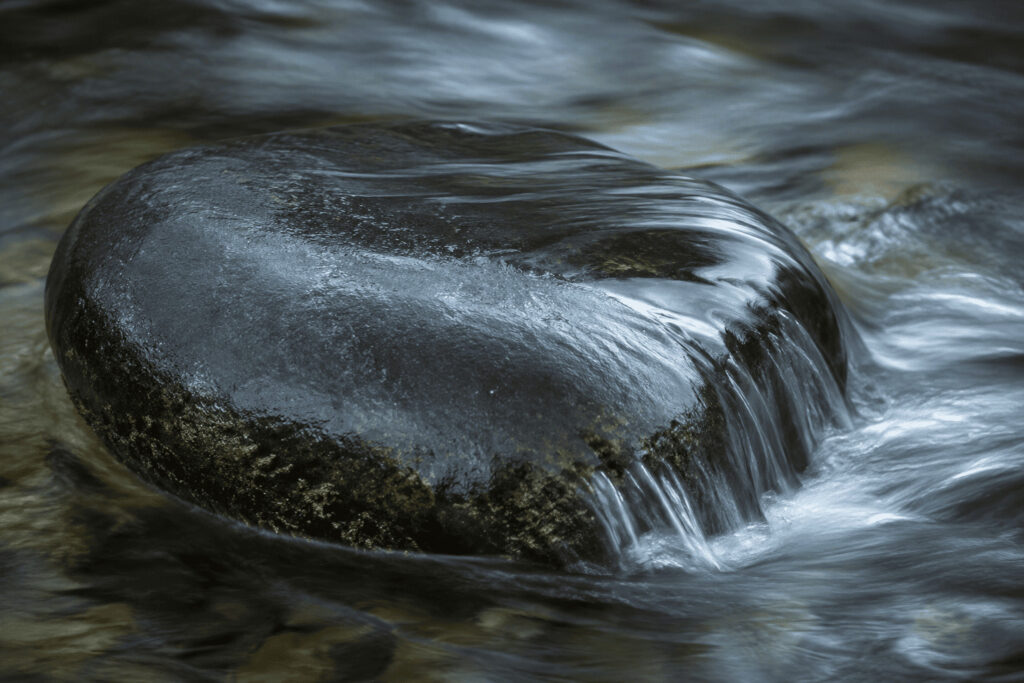
For Laozi, water is the closest image we have of how Wu Wei moves. Nothing in nature seems softer, yet nothing is more relentless. Water yields to every shape it meets and, over time, reshapes everything it touches. This is not metaphor as decoration — it is the most precise teaching the Dao De Jing offers about what effortless action looks like.
Water does not argue with the rock. It flows around it, beneath it, through every crack — and over time, shapes it completely. This is Wu Wei: not the absence of force, but force applied without resistance. It does not strain to overcome obstacles; it simply does not treat them as obstacles. The path of least resistance becomes the river.
In practice, this is the difference between pushing through a wall and finding the door beside it. Wu Wei is not weakness or surrender. It is the recognition that the world has its own grain — and that aligning with that grain accomplishes more than any amount of force ever could.
"The highest good is like water. Water benefits all things and does not contend. It flows in places people reject, and so it is close to the Dao."
Laozi, Tao Te Ching (Dao De Jing, 道德經), Chapter 8
Wu Wei in Daily Life
Practicing Wu Wei does not require rituals or special settings; it begins with how we face everyday situations. To practice it is to develop sensitivity to timing — knowing when to act and when to wait, when to speak and when silence carries more power.
Wu Wei appears in the details of everyday life. It begins where the need to control ends. At work, this means trusting a project's natural rhythm instead of imposing a rigid plan. In relationships, it is letting go of the urge to dictate outcomes and allowing connection to grow on its own terms. Conversation reveals it too: knowing when silence carries more power than words. The body shows it when effort becomes strain — and we choose to soften rather than push harder. And in decision-making, it is the patience to wait for clarity instead of forcing a choice before its time.
Wu Wei and Qigong
The principle of Wu Wei runs silently through Qigong practice. Each posture and breath is an invitation to release tension. Instead of standing stiff and upright, the body settles into balance: rooted yet soft, like a tree swaying with the wind. Breath flows without being pulled or pushed, carrying qi naturally through the channels.
Qigong is often described as “meditation in motion.” That description is most true when we understand it through Wu Wei. Movements are not imposed on the body but allowed to arise, guided by intention that is gentle and unforced. In this stillness-in-movement, energy begins to circulate because nothing obstructs its path. Wu Wei reveals itself here as the art of allowing: finding power in softness and action in stillness.
In practice, this art is trained through the Three Regulations (Sān Tiáo, 三調) — the harmonization of body, breath, and mind that forms the technical core of Qigong.
- Body (Tiáo Shēn, 調身) begins with alignment and stability: standing tall without stiffness, the joints open, the weight settling through the feet. Relaxation is not collapse; it is the deep release that only structure makes possible.
- Breath (Tiáo Xī, 調息) is observation before intervention. The practitioner does not push or pull the breath, but lets it deepen into the lower abdomen on its own. The classical instruction is precise: first focus and effort, then Wu Wei. The breath becomes effortless only after attention has made it so.
- Mind (Tiáo Xīn, 調心) is the regulation of inner noise. As thought quiets, what arises is what the tradition calls the water mind — a consciousness that flows and observes without interfering or judging. It is the same image the Dao De Jing gives us through water itself: presence without resistance.
This is the paradox of Qigong practice: the Three Regulations are deliberate work — Youwei in its purest form. And yet they exist to dissolve into Wu Wei. With patient repetition, the posture, the breath, and the attention become second nature, and what was effort turns into flow. The bridge from Youwei to Wu Wei is built one practice at a time.
Wu Wei in Neigong and Neidan
For more advanced practitioners, Wu Wei becomes a guiding thread in internal work.
In Neigong, intention (yi) directs the practice, but qi is never pushed. Energy responds to awareness naturally; if effort is tense or controlling, flow is obstructed. Wu Wei here is the quiet discipline of trust—allowing energy to move because conditions are right, not because we demand it.
In Neidan (internal alchemy), the principle deepens further. The transformation of jing into qi, qi into shen, and shen into emptiness is not something that can be rushed. The alchemical “elixir” does not appear through force, but through patience and natural maturation. Wu Wei, in this context, is the realization that true transformation is revealed, not manufactured.
The Huainanzi describes this cosmology beautifully: from the Dao arise yin and yang, and from their interplay come the Five Elements. Wu Wei is living in that rhythm—mirroring the natural unfolding of the cosmos within ourselves.
Wu Wei is not about withdrawal from life, nor is it passivity. It is the art of action in harmony with the Dao: gentle, natural, effective. It shows up in Qigong as relaxation, in Neigong as trust in energy, and in Neidan as patience with transformation.
“Returning to the Source is called stillness; this means returning to life-destiny. Returning to life-destiny is called constancy; knowing constancy is called illumination.”
Scripture of Clarity and Stillness (Qīngjìng jīng)
Related Taoist Concepts: Ziran and Pu
Wu Wei does not stand alone in Taoism. It is closely connected with two other key principles:
- Ziran (自然), often translated as spontaneity or naturalness, describes the way life unfolds by itself when nothing interferes. Practicing Wu Wei opens the door to Ziran, allowing movement, breath, and thought to arise naturally. In Qigong, this is the moment when the body finds balance and the breath settles without being controlled.
- Pu (樸), the uncarved block, symbolizes original simplicity—the pure potential of life before it is shaped by convention or ego. Wu Wei helps us return to this state of Pu, where action becomes simple and direct. In Qigong, this is reflected in the practice of standing still, relaxing unnecessary tension, and experiencing the body in its most natural state.
Together, these three ideas create a path: acting with Wu Wei leads us into the natural flow of Ziran, and in that flow we rediscover the simplicity of Pu. Qigong becomes a living expression of this journey, turning philosophy into embodied practice.
Living Wu Wei
To learn Wu Wei is to learn how to live the Dao—not by controlling the world, but by flowing with it. In this way, life itself becomes the practice: a continuous unfolding where effort is light, timing is natural, and harmony is always near.
FAQs: Simple Answers to Common Questions About Wu Wei
Understanding Wu Wei can feel confusing at first. Here are some clear answers to common questions that often arise:
What does Wu Wei mean in simple terms?
It means acting naturally, without forcing.
Is Wu Wei Taoism or Confucianism?
It is a Taoist principle, though Confucian texts sometimes borrowed the term with different nuance.
Is Wu Wei just doing nothing?
No. It is doing what is needed, at the right time, without excess effort.
Is Wu Wei the same as passivity?
No. Passivity is withdrawal out of fear or indifference. Wu Wei is alert, present, and responsive — it acts when the moment calls for it, and only then.
How are Wu Wei and Youwei related?
A: Youwei (有為) is deliberate, intentional action — the structured effort that builds skill. Wu Wei is what emerges when that effort matures: action so aligned with the Dao that nothing is forced. In classical Daoism, water sits at the border between Wu (non-being) and You (being) — an image of this very transition, from intention to flow.
What role does intention (Yi) play in Wu Wei?
A: Yi (意) is the bridge from effort to effortlessness. In early practice, Yi directs the body and breath with deliberate focus; in mature practice, Yi softens into simple attention — a consciousness that observes without forcing. Wu Wei is what arises when intention is so refined that it no longer needs to "do."
How do you practice Wu Wei?
By noticing when effort feels forced, and learning to let go. Meditation, Qigong, or simply observing daily life with awareness can help.
Does Wu Wei work in modern life?
Yes. It helps reduce stress, improve decision-making, and cultivate mindfulness.
What tradition does Wu Wei belong to?
It originates in Taoism, but its wisdom can be applied universally.