

You sleep eight hours and wake up drained. This guide explains why chronic anxiety depletes Jing — the body's deepest reserve — why ordinary rest can't refill it, and what actually rebuilds it: deep breathing, standing practice and, above all, time. Includes how long it usually takes to feel a shift.
You went to bed early. You stayed there. By any reasonable measure, you slept enough.
And you woke up tired.
Not the exhausted that coffee alleviates, or that a good weekend rejuvenates. Before the day has asked anything of you yet in the morning, there lies a deeper kind. The kind that makes the idea of doing the things you used to do feel genuinely far away.
One of the most common and least understood facets of chronic anxiety is this. Not the acute exhaustion after a panic attack — that makes intuitive sense. The persistent, ongoing exhaustion that simply persists, regardless of how much you rest, regardless of how carefully you manage your energy.
Relief isn't addressing it because relief isn't attaining the level where the problem is.
More than 40 million adults in the United States are affected by anxiety disorders. Fatigue is among the most frequently reported symptoms—yet it's rarely addressed directly, because most frameworks treat it as a downstream effect of poor sleep rather than as a primary consequence of the energy depletion that anxiety produces. The distinction has significant implications, because the approach that follows from each framing is fundamentally distinct.
This content is for general information purposes only and does not constitute medical guidance. A qualified healthcare professional should be consulted if you are experiencing persistent fatigue or anxiety.
What anxiety is actually consuming
What chronic anxiety actually consumes
In traditional Chinese medicine, the body isn't merely affected by anxiety as an incidental mental state. It's a sustained draw on the body's energy reserves—specific, measurable in its effects, and irreversible by surface-level rest.
Jing: the reserve sleep doesn’t refill
The fundamental principle is Jing (精) — the vital essence stored in the Kidneys and the lower Dan Tian (丹田). Jing is the body's deepest reserve. It's what you were born with, supplemented by good living—deep sleep, nourishing food, unhurried breath—and depleted by excess: chronic stress, emotional overload, insufficient recovery.
Zhuangzi described the mechanism with a precision that two thousand years of observation has only confirmed: "When you fatigue your body and do not rest, you falter. When you use your spirit and do not cease, you exhaust it." The person who is always output, always pursuing, always generating—that person depletes their Jing not dramatically but steadily, "like a horse at full gallop that no one stops."
Anxiety depletes Jing through two distinct mechanisms. Every sustained activation of the stress response—each unresolved episode of fight-or-flight, each night of shallow sleep, each hour of low-grade vigilance—depletes the foundational reserves directly. The second is indirect: the Qi that should be circulating freely through the body, nourishing the organs and sustaining daily function, becomes stagnant under chronic emotional pressure. Stagnant Qi, as the Aknanda materials put it, "se pudre" — it becomes putrid. It stops being generative. The energy that should be sustaining you sits instead as tension in the tissue and flatness in the day.
Why ordinary rest doesn’t reach it
Why sleep restores Qi but not Jing
The circulating energy of daily function, known as Qi, is where sleep operates. It replenishes what the day spent. But Jing functions at a more profound level. When there isn't enough Qi replenishment from breath, food, and rest, it's the reserve that is drawn upon. And Jing doesn't replenish from ordinary sleep.
This is why the exhaustion of chronic anxiety has a distinct character than the fatigue of a hard week. A good weekend brings relief to the fatigue of a hard week. The fatigue of depleted Jing lingers on Monday, unmoved by the indulgences of Sunday. It has a base that remains unshifted.
The I Ching describes this state in the hexagram K'un — La Desazón, the exhaustion: the lake without water. Arriba, evaporating, below, draining away. The external appearance appears normal. The reserves inside have vanished. "He finds himself exhausted by the trivialities of life, from which there seems to be no escape."
This is not a clinical manifestation of depression, though it can present similarly. The system running on empty, a specific energetic state, requires specific energetic intervention to reverse.
What the Yang without Yin cycle looks like
The Taoist cosmological framework is precise about this: a lifestyle requires sustained Yang with Yin, otherwise, it becomes a pathway to collapse.
The Yang without Yin cycle
Yang is dynamic, expansive, productive. Output, achievement, responsiveness, and vigilance almost entirely drive the modern high-functioning life, which runs on Yang. Anxiety is an excess of Yang—the nervous system that can't downregulate, the mind that can't stop generating, the body that can't shift into the receptive state that would allow actual restoration.
Yin is the necessary counterpart: receptive, inward, restorative. The body doesn't just need rest — it needs genuine Yin. And genuine Yin cannot be coerced. It arises when the Yang has been genuinely completed — when the energy has been moved through its natural cycle rather than suppressed or held in perpetual readiness.
This is why succumbing to the couch with a screen doesn't revive the way practice does. Passive consumption does not equate to Yin rest. It's suspended Yang—the motor running but not in gear. The Jing continues to dwindle because the system never transitioned out of neutral.
What starts to change
From the bottom up, the practice that addresses this works: the lower Dan Tian, the Kidneys, the breath.
Breathing that rebuilds the reserve
Profound abdominal respiration — not the superficial, upper-thoracic respiration that anxiety generates, but the complete diaphragmatic breath that reaches the lower torso — sustains the Kidney Qi directly. Not because it's pleasant or relaxing, but because it restores the system that anxiety has been depleting, is the breath Qigong training prioritizes from the beginning.
The static posture of the Aknanda method, Zhan Zhuang, gradually builds the lower Dan Tian over time. This is slow, gradual work. It requires a considerable period of time. The reserves rebuild consistently when provided the right conditions, making this work directional.
Movement that completes the Yang cycle — specific Qigong sequences that provide a conduit for stagnant energy — enables the Yin to manifest authentically rather than being superimposed. Real movement leads to a different kind of tiredness, distinct from that of depletion. It has completion in it. The body discerns the distinction even when the mind lacks linguistic expression.
How long it takes to feel a shift
Within two to four weeks, most practitioners report the first shift, and the quality of sleep changes. Not necessarily the duration—the depth. The morning contains an element it previously lacked. That's not resolution. That's the direction.
The Transform: Anxiety into Strength and Vitality course is constructed around this progression — beginning with the fundamental energy work, developing towards the ability to endure rather than merely exhaust.
The fatigue isn't the issue. It's the signal. What's depleted can be restored—with the right work, in the right direction.
FAQs: Simple Answers to Common Questions About Anxiety Fatigue
Why does anxiety cause fatigue?
Sustained low-level activation of the sympathetic nervous system, maintained by chronic anxiety, continuously draws on the body's foundational energy reserves and keeps cortisol levels elevated. In traditional Chinese medicine, this corresponds to the depletion of Jing—the vital essence stored in the Kidneys—which explains why anxiety fatigue is persistent and doesn't resolve with ordinary rest.
Why am I always tired even after sleeping?
When the fatigue originates from Jing depletion rather than Qi depletion, ordinary sleep — which replenishes circulating energy but doesn't restore foundational reserves — fails to address the issue. A signal that the depletion is at a deeper layer of the energy system is the exhaustion that persists regardless of sleep duration.
What is the difference between anxiety fatigue and regular tiredness?
A good night's sleep or a restful weekend allows regular tiredness to resolve. Anxiety fatigue persists because it originates in the depletion of the body's foundational reserves—Jing in the Taoist framework—not just the circulating daily energy—Qi. The quality is also distinct: anxiety fatigue often encompasses a dullness or lack of dynamism that isn't merely physical exhaustion.
Can Qigong help with anxiety-related fatigue?
Research confirms Qigong's impact on both anxiety and the exhaustion that accompanies it. A 2009 study by Manzaneque et al. in the Journal of Health Psychology found that one month of Qigong practice improved psychological well-being, including sleep duration—one of the primary pathways through which Jing restoration begins. The mechanisms encompass restoration of parasympathetic tone, deep diaphragmatic breathing that revitalizes the Kidney system, and movement practices that eliminate stagnant Qi.
How long does it take to recover from anxiety fatigue?
Depending on how long the depletion has been accumulating, this varies considerably. Most practitioners notice a shift in sleep quality within two to four weeks of consistent Qigong practice. Deeper rejuvenation — a shift in the fundamental energy pattern — typically unfolds over months. This cultivation, viewed within the Taoist tradition, is directional, not immediate, and sustained by practice rather than any single intervention.
Get new posts by email
When Bharu publishes a new article on Qigong practice and Daoist philosophy, it reaches your inbox. Only new articles, no noise.
Related posts:

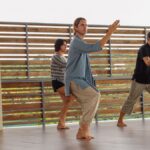

Aknanda Qigong is a wellness brand and academy based in Nosara, Costa Rica, dedicated to the practice and teaching of Qigong, Medical Qigong, and internal martial arts. Founded on authentic Buddhist and Taoist traditions, the method integrates ancient wisdom with modern biomechanics and nervous system regulation. Aknanda offers in-person retreats, online programs, and a 200-hour Teacher Training Certification, all designed to cultivate vitality, mental clarity, and longevity. Recognized as the Best Wellness Center in Central America & the Caribbean, Aknanda Qigong serves a global community of practitioners seeking holistic transformation.
