

Women are diagnosed with anxiety nearly twice as often as men, yet the physical signs — jaw clenching, lower back pain, 3am waking — are the ones most checklists miss. This guide maps those symptoms to the Liver, Kidneys and Heart in Chinese medicine, explains why clinical frameworks overlook them, and shows how Qigong works at the organ level underneath.
The checklist doesn't align. Racing heart, obvious panic, something dramatic and visible — that's what anxiety is supposed to look like. What you have is subtler and, in some ways, harder to live with. Jaw pain that won't resolve. At the wrong moment, irritability arises for no clear reason. Waking at 3am with no particular reason, mind already running. The fatigue that rest doesn't alleviate.
When you bring it up to your doctor, the tests come back normal. You mention it to friends and they say you seem fine. You appear normal from the outside. Yet, beneath all of this, there lies something that eludes the standard portrayal of anxiety.
Women are diagnosed with anxiety disorders at nearly double the frequency of men, according to the U.S. Office on Women's Health. Anxiety in women, according to consistent research, presents differently—with more somatic symptoms, more sleep disruption, and more of the diffuse, body-held tension that clinical frameworks often undercategorize as "stress." The picture most resources describe was built on research that historically underrepresented women. Which means that for a considerable number of women, the conventional guidance — if you don't identify with these symptoms, you likely don't have anxiety — has been actively misleading.
For informational purposes only, this content does not constitute medical advice. If you're experiencing persistent symptoms, please consult a qualified healthcare professional.
What the body-map of anxiety in women actually looks like
Traditional Chinese medicine presents a distinct framework – one that charts anxiety as a disturbance in the body's energy network, with precise physical locations tied to the affected organs.
The foundational principle of the Aknanda methodology is that the body and mind constitute a single psychophysical unit. "The first cause of a disbalance is in the emotional dimension." That cause doesn't necessarily have to be identifiable or linked to a particular incident. The vital energy known as Qi connects the mind, body, and organ system, operating to produce specific, not random, physical patterns.
The three organs involved
For women, three bodily systems are particularly significant.
The Liver: frustration that lives in the body
The smooth circulation of Qi throughout the body is governed by the Liver (木, Wood element). When that circulation is blocked—by unresolved frustration, over-responsibility, or emotions that had nowhere to go—Liver Qi stagnates. The stagnant energy produces heat. That heat rises.
What Liver Qi stagnation feels like
The physical pattern is exact: strain in the trapezius muscles between neck and shoulders, jaw clenching at night, headaches, difficulty taking a full deep breath, a surge of irritability at something objectively minor. A discharge, not a bad mood. The Liver, overwhelmed by accumulated experiences, reacts to even the tiniest new input by unleashing everything it has been holding onto.
This is the body-level reality of what often gets labeled as "being stressed." The tension in the shoulders isn't incidental to the anxiety. It is the anxiety, embedded in the tissue.
The Kidneys: the fear that has no name
The Kidneys (水, Water element) harbor the Jing (精) — the fundamental vital energy that underlies constitutional robustness. Their emotional correspondent is fear: not acute, reactive fear, but the existential kind. The low-level, sourceless sense that something is amiss, a feeling of unease that the foundations are not as secure as they should be.
Jing depletion and sourceless fear
Kidney Qi is depleted by chronic anxiety. The result shows as lower back tension that intensifies under stress, a fatigue that doesn't respond to rest, and the particular form of anxiety that women often describe as "I feel anxious for no reason" — sourceless, diffuse, present regardless of circumstances.
Why anxiety changes your breathing
The kidneys also have a direct connection with respiration. Under chronic fear and stress, the body adapts by breathing shallow and fast, bypassing the diaphragm—a survival mechanism that, over time, deprives the Kidney system of the deep downward breath necessary for restoration. The shortened breath perpetuates the depletion that produces the anxiety that shortens the breath.
The Heart: the mind that won’t settle
The spirit and governing intelligence, the Shen (神), resides in the Heart (火, Fire element). When Liver Qi stagnation and Kidney depletion leave the Heart without its anchors, the Shen becomes dispersed. This is what precipitates the 3am wakefulness: the mind that is nowhere and everywhere, rummaging through matters that are already settled, unable to rest because the underlying system lacks stability.
Shen dispersion and 3am waking
It also produces what the Aknanda materials describe as the experience of attention being "trapped in the head, disconnected from our physical center." The chest closes. The shoulders round. The body adopts the stance of someone tensing, even when there's nothing to prepare for.
Why women’s anxiety often goes unrecognized
Women most frequently report the somatic pattern — the jaw, the shoulders, the lower back, the wakefulness. Clinical frameworks, built on research that historically centered male presentation, look for worry, cognitive symptoms, and obvious distress. They frequently overlook the physical manifestations of distress.
Why clinical frameworks miss it
Traditional Chinese medicine is not encumbered by this issue. The body is where it begins. It has always been about the body. The correlation of anxiety to specific organs and their physical domains signifies that jaw tension is not a secondary symptom to be noted and set aside — it is diagnostic information about the state of the Liver and Spleen systems. The lower back ache isn't incidental to the anxiety — it is the Kidneys telling you what they need.
It changes what you address, making this matter practically. Cognitive approaches work on the thought layer. Bodywork targets the musculature. Qigong works on the organ system underneath both — the energetic substrate that is generating the physical pattern and the mental state simultaneously.
What changes when you work at the organ level
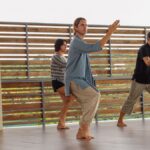
The practice Bharú teaches at Aknanda engages directly with this substrate. Specific organ systems are targeted by each sequence of movements. The Liver work releases the stagnant Qi that's been generating heat and tension. The Kidney work — grounding, profound diaphragmatic respiration, the standing practice of Zhan Zhuang — rebuilds the foundational reserves. Through the anchoring of awareness in the lower Dan Tian (丹田), the Heart work provides a foundation for the Shen to rest upon.
Physical symptoms do not resolve as a result of the byproducts of mental work. They resolve because they are being addressed at their source—which has always been the body's energy system, not the symptom it produces.
"In our experience teaching this," the Aknanda methodology states, "[the practice] proposes the encounter with the present time, stimulating the connection of body, mind, breath at the service of self-knowledge." Not therapy. Not relaxation. A system that functions holistically — because the entire system is where the anxiety resides.
The jaw knows. The shoulders know. The lower back knows. The practice develops the ability to tune in to what the body has been communicating.
FAQs: Simple Answers to Common Questions About Anxiety Symptoms in Women
What are the physical symptoms of anxiety in women?
Somatic symptoms such as jaw tension, nighttime teeth grinding, chronic tightness in the shoulders and upper back, difficulty breathing deeply, lower back pain under stress, disturbed sleep (especially 3am waking), fatigue that doesn't resolve with rest, and irritability that seems disproportionate to the trigger often affect women with anxiety. These often coexist with, or substitute for, the cognitive worry symptoms that clinical frameworks prioritize.
Why do women experience anxiety differently than men?
Research suggests that anxiety disorders manifest with a greater prevalence of somatic symptoms in women, implying a higher incidence of physical, bodily expressions compared to cognitive ones. Fluctuations in hormonal factors, such as those across the menstrual cycle and in perimenopause, also impact the Liver Qi and Kidney Yin systems, thereby intensifying anxiety. The historical underrepresentation of women in anxiety research means that clinical descriptions have often failed to acknowledge this pattern.
What does traditional Chinese medicine say about anxiety in women?
TCM primarily maps women's anxiety to three organ systems: the Liver, which experiences frustration and stagnation, leading to shoulder tension, jaw clenching, and irritability; the Kidneys, affected by fear and depletion, resulting in lower back tension, sourceless anxiety, and fatigue; and the Heart, where Shen dispersion causes wakefulness, inability to rest, and mental restlessness. The physical symptoms are understood as information about which organ system needs attention—not as secondary effects of a mental condition.
Can Qigong help with anxiety symptoms in women specifically?
Studies support Qigong's effect on anxiety. The 2014 Wang et al. meta-analysis found significant anxiety reduction after regular practice. The specific mechanisms — hepatic Qi liberation, renal rejuvenation, parasympathetic activation — address the somatic patterns that characterize women's anxiety presentation. Within the first weeks of consistent practice, many practitioners note that jaw, shoulder, and sleep symptoms begin to shift.
Why do I wake up at 3am with anxiety?
The peak activity window of the Liver system (11pm-3am), according to traditional Chinese medicine, corresponds to the 3am waking. Liver Qi stagnation that hasn't been released during the day generates heat that rises and disturbs the Heart Shen during the body's natural deepest rest window. The practice addresses this by facilitating Liver Qi release in the evening and cultivating Kidney Yin, which stabilizes the Heart throughout the night.
Get new posts by email
When Bharu publishes a new article on Qigong practice and Daoist philosophy, it reaches your inbox. Only new articles, no noise.
Related posts:


Aknanda Qigong is a wellness brand and academy based in Nosara, Costa Rica, dedicated to the practice and teaching of Qigong, Medical Qigong, and internal martial arts. Founded on authentic Buddhist and Taoist traditions, the method integrates ancient wisdom with modern biomechanics and nervous system regulation. Aknanda offers in-person retreats, online programs, and a 200-hour Teacher Training Certification, all designed to cultivate vitality, mental clarity, and longevity. Recognized as the Best Wellness Center in Central America & the Caribbean, Aknanda Qigong serves a global community of practitioners seeking holistic transformation.
