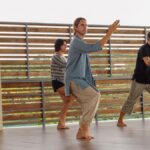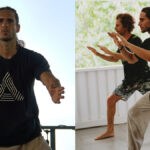

Within the heritage of Shaolin Qigong and Dao Yin (導引), we find universal and recognized milestones such as Baduanjin (八段錦) (Eight Pieces of Brocade), Yi Jin Jing (易筋經) (Muscle and Tendon Changing Classic), and Xi Sui Jing (洗髓經) (Brain and Bone Marrow Washing Classic).
Uncovering the Principles and Personal Morphology
Throughout my years of practice, I have had the opportunity to work with a large part of this traditional material, and I can assure you that the experience was never identical. There were similarities, of course, but the way of executing the movements or holding the postures changed according to the lineage.
At first, it was difficult to comprehend. However, through years of practice and observation, I came to recognize two fundamental truths:
- The principles are what matter: Each exercise is designed to provide and develop a specific quality (elastic force, opening, rooting).
- There is no single way to move: After years of copying a teacher, practitioners must conduct their own investigation, considering their personal morphology to make the best use of that physical vehicle and unfold the underlying principle.
Furthermore, the great legacy of Shaolin is its representation of Chan (Chan, 禪) Buddhism, also known as Zen. This influence was not confined to China; it expanded to other branches of Buddhism and temples in diverse regions, where I was also fortunate enough to experience special Qigong systems that broadened my vision.
This is the profound context from which The 14 Jewels emerge: a Qigong of Buddhist lineage.
Anatomy of the Practice: The Link Between Yi and Qi
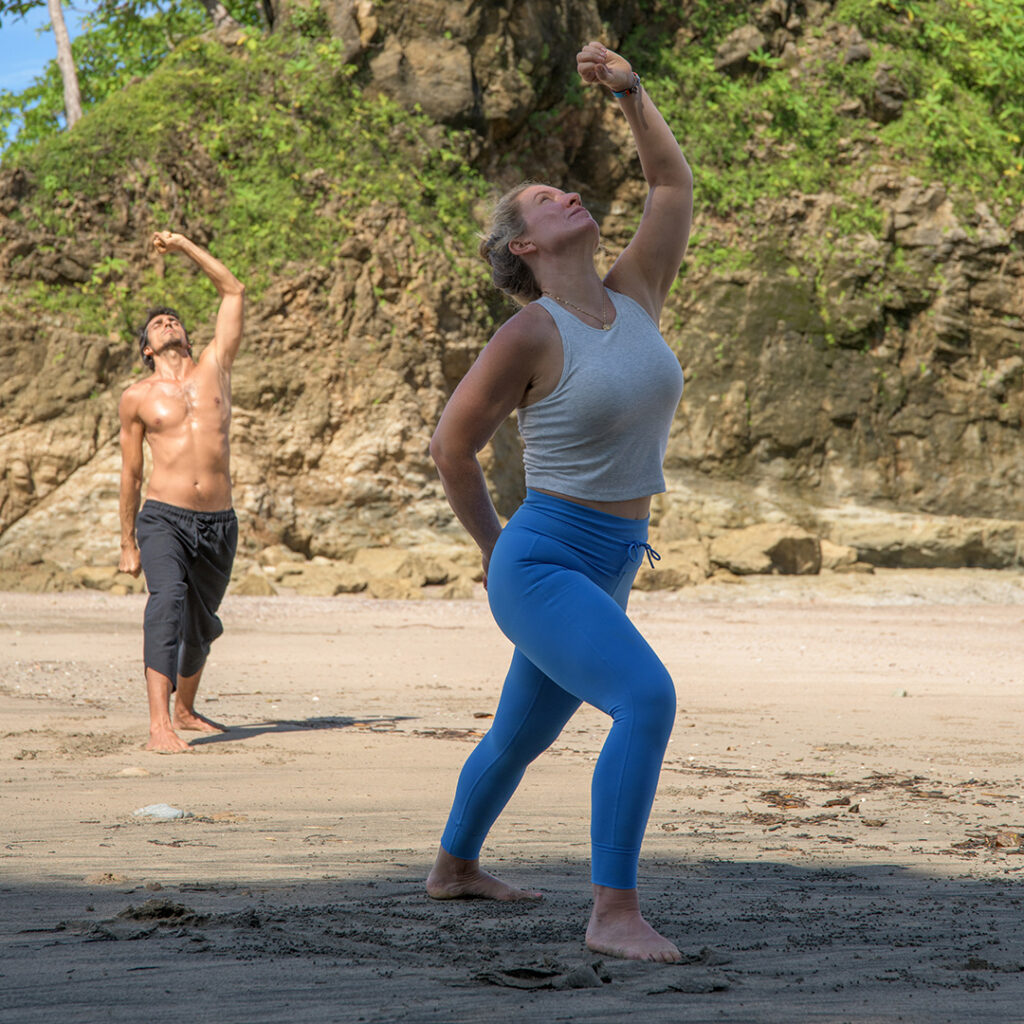
As a general characteristic, these Qigong systems aim to regulate movement and breath, strengthen the internal body, improve the quality of the meridians, and enhance the body's fascial system.
On the mental plane, the practice seeks to embody a state of mindfulness or Buddhahood, placing emphasis on correct concentration. The goal is for the physical movement to be completely inhabited by Yi (意)—intention and attention—so that Qi (氣), or vital energy, can be mobilized efficiently.
Unlike other dynamic styles that rely on high continuity or a purely circular nature, this family of Qigong is divided into static and semi-static postures or movements that open and close the structure. Each exercise targets a specific area: a muscular chain, an organ, or a particular meridian. This methodology allows the practitioner to focus millimetrically on each area and each respiratory cycle.
The Birth of the Method: The Aknanda Approach
When designing the methodology and syllabus for Aknanda Qigong, the great challenge lay in translating the knowledge acquired from different lineages and generous masters into a system at the service of a modern community. The wisdom of Buddhist Qigong, rooted in the Shaolin Temple, was an obligatory beacon; it had to become one of the fundamental pillars of our approach.
However, I faced an undeniable reality: people need powerful and effective tools, but in today's daily life, memorizing and practicing routines of 30 or 40 postures is highly challenging. Time is scarce.
From my perspective, accumulating sheer quantity was not necessary. Beyond decorative names, the most rigorous task was to sustain the essential principles and their healing power.
After years of research, refinement, and methodological design, I synthesized this entire experience into a sequence of no more than 14 essential movements and postures that embody the pure essence of Shaolin and Buddhist Qigong. Grounded in Yi Jin Jing as the foundational axis of Neigong work, and integrating select interpretations of Baduanjin, Shu Jin Gong (舒筋功), and a rare style steeped in Theravada Buddhism, The 14 Jewels of Qigong took definitive shape: an original structure and synthesis exclusive to Aknanda Qigong.
The 4 Sections of the 14 Jewels
This sequence is studied through four clearly differentiated sections. Each possesses its own character, personality, physical objective, and unique energy. They are four worlds integrated into a single physical blueprint:
- Section 1 (5 Postures): Stimulates the central, vertical, and horizontal axes of the body. It places special emphasis on the lungs and on understanding Yin and Yang within the biomechanics of the exercise. The level of muscular activation can be regulated from gentle to high.
- Section 2 (3 Postures): Develops rooting and structure through Ma Bu (馬步) (Horse stance) and Gong Bu (弓步) (Bow stance), articulated with movements of opening, folding, emission, and reception of pressure. Muscular engagement is moderate to high.
- Section 3 (2 Postures): Focused on the Buddha Palms (Lohan, 羅漢), expressing the separation of heaven and earth through twisting and advanced mobility of the shoulders and neck. It places a rigorous emphasis on stimulating air exchange, cleansing and tonifying the lungs.
- Section 4 (4 Postures): Dedicated primarily to spinal health through mobility, flexion, and tonification exercises, stimulating kidney energy (Water element) to culminate in the final jewel: the mother posture of Wuji (無極) (the primordial void).
Comprehensive Benefits of the Practice
The purpose of this system is to equip the human being with a complete mechanics that favors the free flow of energy. For Qi and blood to move with vigor and balance, solid physical and structural conditions must exist to support them. That is where the 14 Jewels operate, reshaping fascial and energetic anatomy:
- Physical Structure: Develops a strong, flexible, and elastic body.
- Fascial and Tendinous System: Deeply strengthens and stimulates fascia, tendons, ligaments, and energy channels.
- Vitality: Increases overall energy levels and endurance.
- Mental Focus: Radically improves concentration, body memory, and mindfulness.
- Organic Efficiency: Cleanses, rejuvenates the respiratory system, and optimizes internal organ functions.
- Direction of Yi: Enhances the conscious ability to direct your intention and your energy.
How to Integrate the 14 Jewels into Your Routine
One of the great advantages of this design is its versatility. The form can be executed in a gentle, moderate, or even intense manner, depending on the type of energy your body and mind need to regulate at any given moment to restore balance.
Nevertheless, the recommendation for beginners is to work with moderate energy, right at the midpoint between the hard and the soft. Once you assimilate the map of the movement and gain expertise, I encourage you to play with the instrument, alternate intensities, and experience the different states it produces.
Today, through our instructors, students, and practitioners worldwide, the distribution of this system continues to grow. Many people are already enjoying the benefits of this Buddhist Qigong family under the unique organization and method of our academy. The legacy grows, expands, and is our greatest reward.
Knowledge Informs, Wisdom Practices
Words have the capacity to inform and trace the map, but true transformation will only occur through direct experience within your own body. The 14 Jewels are not a collection of forms to memorize—they are a condensed instrument to reshape your fascial anatomy, strengthen your organs, and unify your intention with the flow of your energy.
The Shaolin legacy lives not in repetition but in embodiment. The map is here. The territory waits in your own practice.