

There's no trigger, no meeting you're dreading, nothing urgent happening, yet the feeling stays. This guide explains what Chinese medicine calls Qi stagnation, why searching for a cause keeps the loop going, and how Qigong works on the body instead of the narrative — and why the absence of a reason doesn't mean the absence of a cause.
You're not anticipating a dreaded encounter. A crisis in any relationship is absent. Nothing urgent is happening. And yet the feeling persists — amorphous, unlocatable, the nagging intuition that something is amiss without being able to pinpoint the cause.
You've looked for the trigger. You've tracked your sleep, your caffeine, and your cycle. You've tried naming the feeling, sitting with it, breathing through it. From nowhere it still returns, announcing nothing.
The lack of a rationale doesn't imply the absence of a precipitating factor.
Generalized Anxiety Disorder — the most common anxiety diagnosis in the United States — is characterized by persistent, excessive worry that is difficult to control and not attached to a specific threat. The DSM describes it as "free-floating" anxiety: present across situations, not linked to a particular object or event. Neurologically, this corresponds to an impaired threat-processing mechanism. Even in the absence of a real threat, the amygdala, chronically sensitized by prolonged stress, sleep disruption, or hormonal fluctuation, generates a threat response. The alarm goes off not because something is amiss but because the alarm system has been on for too long, its sensitivity heightened by the passage of time.
Western medicine accurately delineates this mechanism. But for this particular pattern, where there isn't a cognitive cause to identify, what it doesn't always offer is an entry point.
For informational purposes only, this content does not constitute medical advice. If you are experiencing anxiety, please consult a qualified healthcare professional.
What Chinese medicine maps
Traditional Chinese medicine approaches this pattern from a fundamentally distinct perspective. The Aknanda methodology states it directly: "the first cause of a disbalance is in the emotional dimension" — and that cause doesn't need to be conscious, nameable, or traceable to an external event. The emotional dimension acts on the Qi, which acts as transmitter between mind and body and organs. When that transmission is disrupted, the body produces tangible, physical signals — even in the absence of a discernible narrative cause.
Qi stagnation: the mechanism behind sourceless anxiety
Qi Stagnation (气滞, qì zhì) is the primary mechanism. When Qi—the vital energy that circulates through the meridian system—is blocked or fails to flow smoothly, the result is a specific cluster of experiences: a vague sense of unease, emotional restlessness, the feeling that something needs to happen but nothing is happening. The Liver meridian, which regulates the unobstructed circulation of Qi throughout the body, is most commonly implicated. Liver Qi Stagnation is one of the most prevalent patterns in contemporary Chinese medicine practice — and it maps almost exactly onto what people describe when they say they feel anxious for no reason.
The absence of a cognitive narrative doesn't mean the source is a mystery. The source isn't psychological — it is energetic. And an energetic source responds to energetic intervention.
The location of anxiety without cause
In the Taoist framework, anxiety characteristically arises when attention becomes trapped in the head, disconnected from the body's physical center. As the Aknanda methodology describes: "anxiety and mental fatigue often arise when our attention is 'trapped' in the head, disconnected from our physical center."
Why the mind loops when it cannot find a cause
This matters for understanding the sourceless variety specifically. If the mind cannot find a cause when it is searching, it loops, generating more mental activity in the search, which amplifies the sensation it was trying to explain. The loop is not the cause. It's the outcome of attention focused upward and inward without a stabilizing influence.
Shen in the Heart
In Taoist physiology, the Shen (神), which governs mental clarity, resides in the Heart. When Qi stagnates and fails to nourish the Heart, the Shen becomes quietly unsettled. Not acutely — not in extremis — but subtly, tenaciously. Because it isn't responding to narrative, a baseline of unease persists without resolution. It's responding to the state of the energy system underneath, not to the narrative.
The Aknanda materials extend their analysis: anxiety without apparent cause is described as "a non-cognitive, psychic phenomenon rooted in the unconscious" — an existential fear, a fundamental distrust that doesn't necessitate a specific object. What happened doesn't give rise to it. It comes from the system's relationship with uncertainty itself.
What this changes about how you approach it
Often, searching for the cause of sourceless anxiety is the least useful thing you can do with it. Not because understanding doesn't matter, but because the search increases the very mental activity that amplifies the pattern.
How Qigong approaches it
The Qigong approach sidesteps the narrative entirely. Instead of inquiring about the reason, it queries the location — and subsequently mobilizes the energy that has become stagnant there. The practice works on the Liver Qi directly through specific movement sequences. It stabilizes the Shen by directing awareness from the crown to the lower Dan Tian (丹田) — the central hub of energy below the navel that serves as the body's physical and energetic foundation. Slowing and deepening the breath shifts the autonomic nervous system out of a sensitized state that produces false alarms.
Identifying the trigger is not necessary for this pattern. Because the trigger isn't the issue for this pattern, it needn't be identified.
The Qi is. Qi responds to practice rather than to understanding.
The Transform: Anxiety into Strength and Vitality course is built around this. Each routine has a specific objective within the energy system: the Liver Qi work, the Dan Tian anchoring, and the breath regulation. These aren't supplementary techniques layered on top of an understanding of anxiety. These direct interventions target the system responsible for generating anxiety.
You don't have to know why you feel it. You just have to move the energy that's stuck.
FAQs: Simple Answers to Common Questions About Anxiety Without a Clear Cause
Why do I feel anxious for no reason?
The amygdala can become hyperresponsive, generating a stress response without an identifiable external stimulus. In traditional Chinese medicine, the same pattern is associated with Liver Qi Stagnation: blocked vital energy leading to emotional restlessness and unease without a cognitive narrative cause.
Is anxiety without a cause normal?
Yes. Generalized anxiety—characterized by worry not linked to a specific threat—is the most common anxiety diagnosis in the United States. The absence of a clear trigger is a defining feature of the pattern, not an exception within it.
What is Liver Qi Stagnation?
Liver Qi Stagnation (气滞) is a fundamental concept in traditional Chinese medicine. Throughout the body, the Liver oversees the smooth flow of Qi. When that circulation is blocked — by stress, emotional suppression, sedentary patterns, or chronic tension — the result includes irritability, chest tightness, sighing, and a sourceless sense of unease or anxiety.
Can you treat anxiety without knowing its cause?
Yes. Qigong and related mind-body practices work on the physiological and energetic substrate of anxiety—not on its narrative content. A 2014 meta-regression of randomized controlled trials (Yin & Dishman, Mental Health and Physical Activity) found that Tai Chi and Qigong produced small-to-moderate reductions in anxiety and depression symptoms. Identifying a cognitive cause is not necessary for the mechanism to work.
How does Qigong help with anxiety that has no clear trigger?
Qigong addresses the Liver Qi stagnation pattern through movement that revitalizes energetic flow, breath work that stimulates the parasympathetic nervous system, and postural anchoring that redirects attention from the head to the body's physical core. Regardless of whether a narrative cause can be identified, these interventions alter the state of the system that produces anxiety.
Get new posts by email
When Bharu publishes a new article on Qigong practice and Daoist philosophy, it reaches your inbox. Only new articles, no noise.
Related posts:

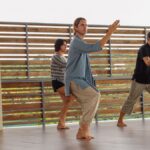
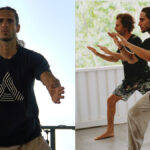
Aknanda Qigong is a wellness brand and academy based in Nosara, Costa Rica, dedicated to the practice and teaching of Qigong, Medical Qigong, and internal martial arts. Founded on authentic Buddhist and Taoist traditions, the method integrates ancient wisdom with modern biomechanics and nervous system regulation. Aknanda offers in-person retreats, online programs, and a 200-hour Teacher Training Certification, all designed to cultivate vitality, mental clarity, and longevity. Recognized as the Best Wellness Center in Central America & the Caribbean, Aknanda Qigong serves a global community of practitioners seeking holistic transformation.
